THE DEVIL WEARS PRADA 2

THE DEVIL WEARS PRADA 2
A Film by David Frankel
When Miranda Meets the Algorithm
Imanos Santos — For Diamont Média
Authority — Algorithm — Vertigo
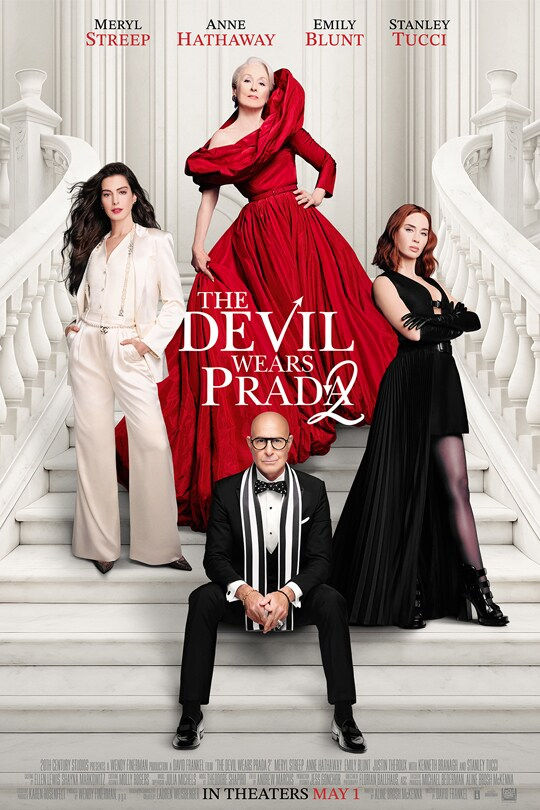
Twenty years later, The Devil Wears Prada 2 returns with a question burning on my lips: who decides value today? Miranda embodies the authority of the gaze, facing the algorithm, budgets, speed. A sequel that speaks of fashion, yet dissects above all our era.

This second chapter arrives in a period where elegance is measured in numbers, taste is evaluated in curves, where trends are fabricated by the second. Miranda Priestly returns, and with her a simple, almost brutal truth: value today is decided between several forces. The editor-in-chief, the platform, the influencer, the advertiser, the algorithm, and the human eye that refuses to disappear. This film has always spoken of fashion. It speaks also and above all of power. And this time, it speaks of a power that leaves Miranda's hand to enter the machine of trends.
I feel this work through three qualities. Three beats. Three angles to understand what unfolds behind the veil of circumstance.
Authority
Miranda Priestly has never been only a magazine figure. She has also been a function. An authority. A person capable of saying "yes" or "no," and imposing hierarchy in a world that adores confusion. She embodies something increasingly lost: an assumed decision.
In the first film, her power rested on what we could think of as logical evidence: expertise, the gaze, culture, the capacity to cut through. Taste had a face. It had a voice. It had coldness, sometimes, yet within the coherence of gesture. And this coherence produced a system. One could hate it. One knew it existed.
Today, authority has changed substance. It does not disappear. It shifts. It leaves the person. It fragments. It becomes diffuse. It passes through buzz, through brands, through data, through speed. Miranda returns to a world where her power no longer rests solely on her charisma or reputation. It rests on a more concrete struggle: surviving in a crumbling industry, and negotiating with forces that no longer respect the same logic.
This return holds something fascinating: it forces Miranda to confront a contemporary truth. Prestige is no longer enough. Authority must prove its value in a universe where value is calculated.
And there, the question exceeds fashion. It touches culture. It touches our era.
Algorithm
An algorithm does not wear a dress. It wears a verdict.
Today, a trend is fabricated in a few hours. A video suffices. A photo turns. A comment swells. Then the object becomes "desirable" because it circulates, not because it has value. Taste becomes a crowd movement, and this movement is measured in statistics. In this context, Prada 2 can become a film about the sovereignty of the gaze. About the slide from human judgment toward calculated judgment. About that invisible phrase governing everything: "what works." And behind "what works," another phrase: "what sells."
The film can then pose a modern, very concrete tension.
On one side, a magazine, an editorial line, a vision. On the other, advertising budgets, luxury groups, influence strategies, performance imperatives.
It is no longer only Miranda who dictates. It is the flows. It is the numbers. It is the partners. It is the campaigns. It is the trends already decided elsewhere.
And this is where the film becomes political, in the noble sense. It speaks of the way a civilization chooses what it looks at. It speaks of the power of attention. It speaks of how the contemporary world replaces authority with instant adhesion.
In such a universe, elegance can become a prison. Because one must follow. Because one must be seen. Because one must produce.
The devil, here, is no longer only a character. The devil is the cadence.

Vertigo
The first film already told this essential thing: ambition has a price. So does style. The world of prestige offers nothing for free. It demands total availability, resistance, a form of self-abandonment.
Today, this vertigo is broader. It exceeds the editorial room. It touches everyone. Because the logic that governs fashion now governs part of our lives: performance, image, rhythm, competition, silent fatigue. An entire era sometimes resembles a permanent editorial room. Everything is seen. Everything is compared. Everything is evaluated. Vertigo is this: living under continuous judgment.
And this is where the sequel can surprise. It can tell a more intimate war than the war of outfits. A war of breathing. A war of presence. A war to maintain an axis when the world accelerates.
Miranda, in this context, can become a paradoxical figure. She remains harsh. She remains demanding. She remains cutting. Yet, facing the algorithm, she also represents a last bastion of the embodied gaze. A gaze one can contest, yet which assumes its subjectivity. A gaze that says "I choose." A gaze that does not need to justify itself through statistics.
And around her, the other characters take on new dimension. Because twenty years later, the world has changed. Power circulates. Roles reverse. Former subordinates sometimes become decision-makers. Former sarcasm sometimes becomes strategy. The film can play with this, and it is very rich material. The era loves returns, yet it also demands accounts.
This vertigo, in the end, poses a fundamental question.
Does taste still belong to someone? Or does it belong to the machine?
Worth pondering!

"Numbers fabricate value. Taste attempts to defend it." — Imanos Santos
The Devil Wears Prada 2 can be a brilliant, sharp, spectacular sequel. It can also be better than that: a precise mirror. A film about authority that shifts, about the algorithm that swallows, about vertigo that fatigues.
Fashion remains a backdrop. The real subject is the gaze.
"Authority, algorithm, vertigo: three forces dispute our era, and style becomes their battlefield." — Imanos Santos
April 29, 2026 in theaters | 1h 53min | Comedy, Drama


