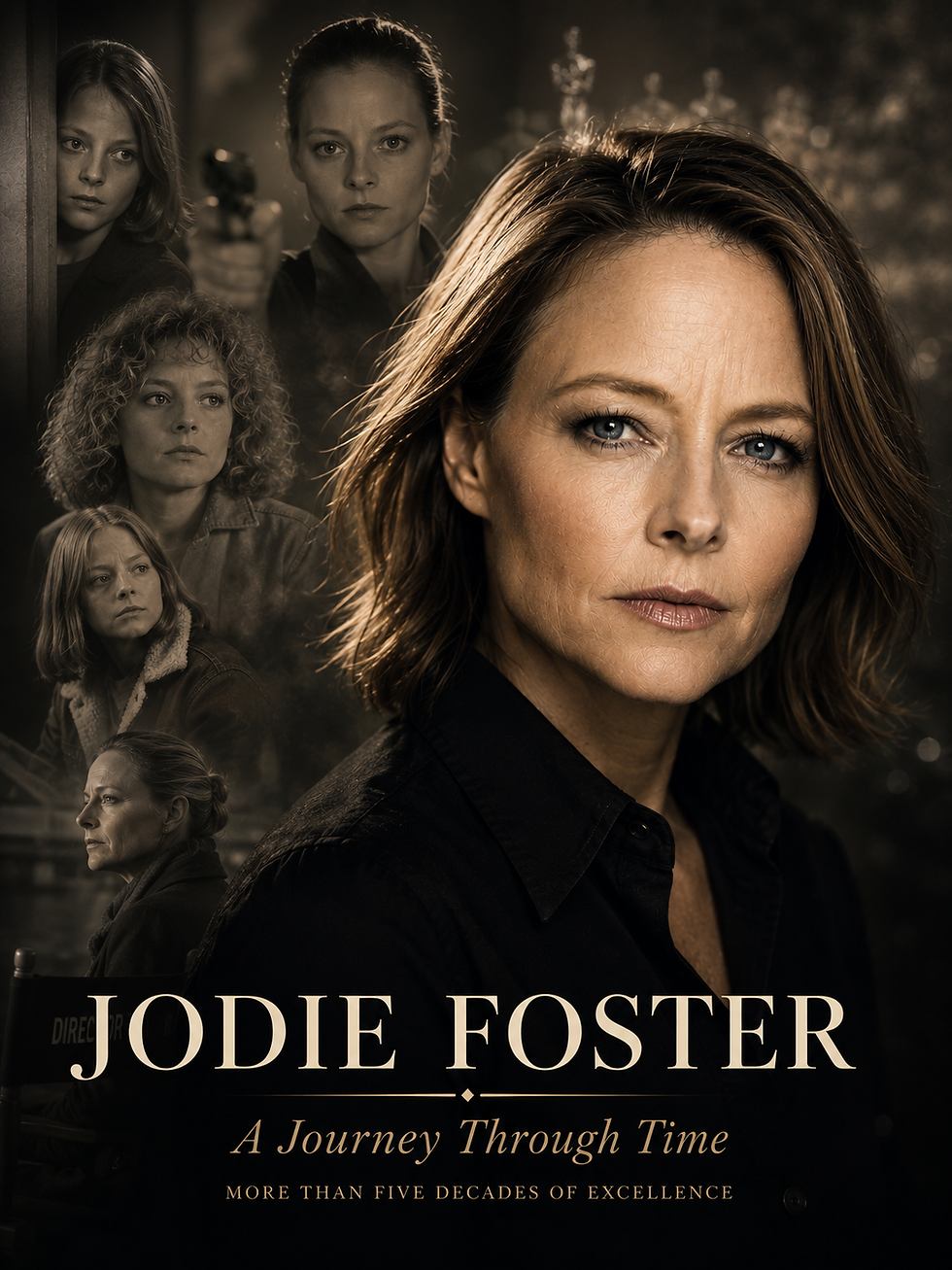
JODIE FOSTER

JODIE FOSTER
Between Shadow and Light
By Serge Leterrier
At sixty-three, Jodie Foster is afraid. She said so herself, on the stage at Cannes 2025, before the world's press gathered for the presentation of A Private Life: she had been too afraid to take on a leading role spoken entirely in French. Fifty years of career, two Oscars, films that have entered the legend. And yet, fear. That sentence perhaps says everything about the way this woman inhabits her craft. Fear as a compass. Fear as a signal that something is worth attempting.

A Private Life, directed by Rebecca Zlotowski, is therefore her first major role performed entirely in French. In this intimate thriller presented out of competition at Cannes 2025, she plays Lilian Steiner, a renowned psychoanalyst whose armour cracks the day Paula, her patient played by Virginie Efira, disappears. Convinced that it was murder, Lilian abandons her professional composure and throws herself into a personal investigation, supported by her ex-husband, played by Daniel Auteuil. The film brings together three of the most powerful presences in European cinema around a story of vulnerability, truth and secret lives. A subject that suits her well.
Jodie Foster has spoken French since childhood, having grown up attending a French school in Los Angeles. Yet she long declined proposals from French directors, afraid of not being equal to the task. "When I act in French, I am a totally different person," she says. "I have a much higher voice, I am much less confident, I get frustrated because I cannot express myself as well. And paradoxically, that creates a new kind of character for me." What others would experience as a handicap, she turns into creative material. This is a constant in the way she moves forward: transforming the obstacle into an engine.

Rebecca Zlotowski, whom Foster readily compares to David Fincher for her exacting standards on set, subjected her to a formidable preparation process. "We reviewed the entire film, word by word, for six or seven hours straight," the actress recalls. "I knew then that Rebecca was someone who took her work very seriously, that she had specific ideas for every part of the film." That kind of rigour is something Foster recognises immediately. She has practised it all her life.
Her career begins very early, under the lights of Martin Scorsese's Taxi Driver in 1976. Where many child actors struggle to find their footing as adults, she builds her artistic identity methodically. A first Oscar for The Accused in 1988. Then comes The Silence of the Lambs, and a story that says much about her determination. Jonathan Demme wanted another actress to play Clarice Starling. Foster took a flight, knocked on his office door and convinced him to choose her. She receives her second Oscar. The character of Clarice enters the history of cinema.
That journey does not stop there. Nell in 1994, Contact in 1997, Panic Room in 2002, The Mauritanian in 2021: each decade sees Foster choosing roles that refuse the easy path. Women who search, who resist, who carry questions the world sometimes prefers to leave unasked. This consistency of choice is not the product of chance. It reveals an artist driven by deep intellectual curiosity, a woman who reads, who reflects, who decides with a rare awareness of what she wants to say to the world through her work.
Fifty years of career, and still this capacity to put herself at risk. That is undoubtedly the secret of her longevity. Jodie Foster has never sought safety. She has sought the truth of her characters, even when that required crossing real fears. Each new territory has transformed her rather than simply been conquered by her.
What strikes us about her acting is this particular economy of means. A contained emotion runs through her performances. A discreet intensity expresses itself through a glance, a posture, a simple inflection of voice. She never reaches for effect. She reaches for the right presence. And it is this restraint that creates a particular closeness with the audience. The characters she embodies seem profoundly real because they avoid artifice.

She has also chosen, on several occasions, to step behind the camera, with Little Man Tate in 1991 and Home for the Holidays in 1995. Not out of ambition to change her identity, but out of genuine curiosity for all dimensions of cinematic language. This approach reveals an artist who considers cinema a living territory, always to be explored, never entirely mastered.
In an era dominated by permanent exposure and instant communication, she has always cultivated a certain reserve. Not by calculation, but by nature. That discretion has never held back her popularity. It has given her a depth that media overexposure so often erodes.
At sixty-three, she could have chosen the safety of familiar roles and mastered territories. She chose French, fear and Rebecca Zlotowski. That choice says it all. Jodie Foster lasts because she refuses to settle. Because fear, for her, is never a reason not to move forward. It is most often the signal that something is worth attempting.
Great careers are not built on talent alone. They are built on faithfulness to an inner demand that time does not manage to wear down. Jodie Foster is living proof of that. Film after film, language after language, character after character, she composes a body of work that endures because it continues, simply, to be true.