NUREMBERG
- Serge Leterrier

- Jan 20
- 6 min read
NUREMBERG
When Evil Becomes a Mirror
By Serge Leterrier
The Trap of Understanding
On January 28, 2026, the anniversary of Auschwitz's liberation, James Vanderbilt's Nuremberg arrives in theaters, starring Russell Crowe, Rami Malek, and Michael Shannon. Beyond its historical recreation of the 20th century's most significant trial, the film poses a dizzying question rarely explored in cinema: what happens to the consciousness of a man who must look absolute evil in the face and attempt to understand it without losing himself?
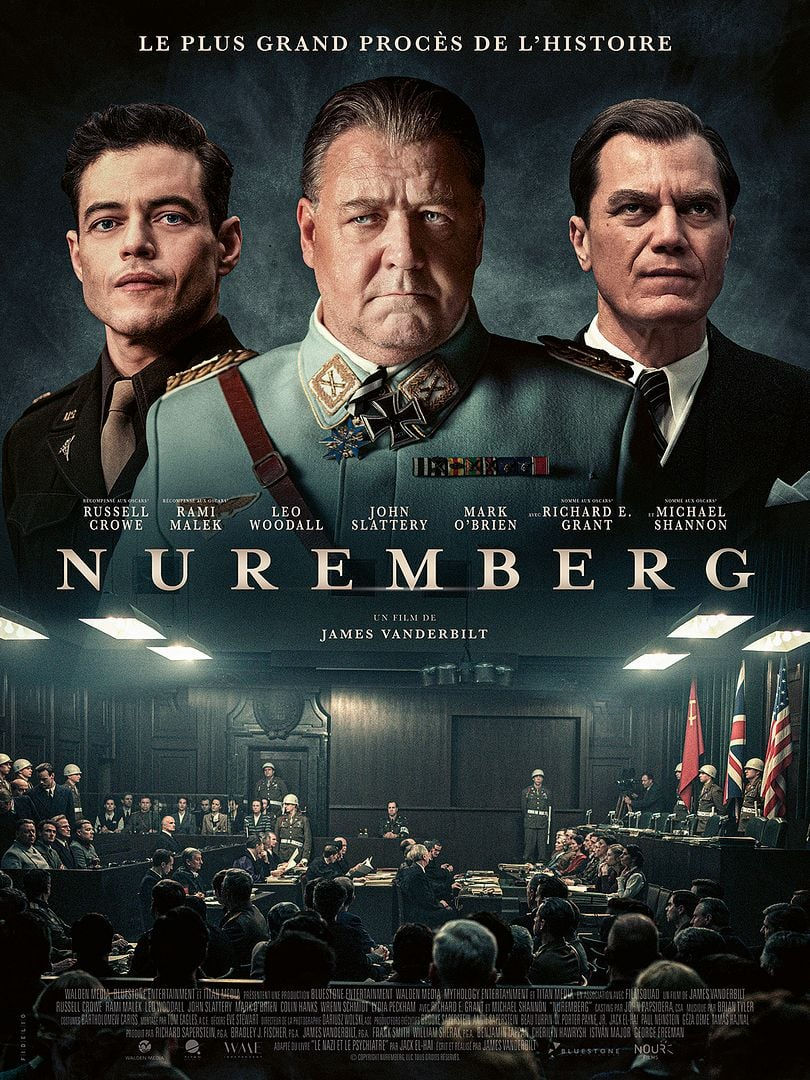
History records that the Nuremberg trials, opened in November 1945, marked the first international tribunal to judge crimes against humanity. Twenty-four Nazi dignitaries appeared before the Allied powers to answer for the unspeakable. But behind the archival footage and judicial records, there was another battle, more silent, more troubling: the one that opposed American psychiatrist Douglas Kelley to Hermann Göring, Hitler's right-hand man and architect of the Nazi death machine.
James Vanderbilt chooses to film this psychological duel rather than the trial itself. And this narrative choice opens a fascinating breach: Nuremberg becomes less a historical film than a meditation on the nature of evil and what becomes of consciousness when exposed too long to the abyss.
The Trap of Understanding
Douglas Kelley arrives in Nuremberg with the certainty of a scientist. His mission is clear: evaluate the mental state of the accused to determine if they are fit to stand trial. For him, Nazi evil must have a rational, psychiatric explanation. He searches for childhood traumas, mental pathologies, psychological mechanisms that would explain the inexplicable.
This quest for understanding is not trivial. It rests on a belief deeply rooted in modern Western culture: that everything can be explained, rationalized, put into words. If we understand why the Nazis acted this way, then we can prevent it from happening again. Evil becomes an object of study, an enigma to solve.
But this is precisely where the trap lies. In seeking to understand evil, Kelley puts himself in a position of vulnerability. He agrees to enter into dialogue with horror, to lend it an attentive ear, to consider it as an analyzable phenomenon. And in this apparently innocent gesture hides a formidable danger: that of giving evil a legitimacy, a humanity, a complexity that could make it... understandable. Therefore excusable.

Göring, the Seducer of the Abyss
Facing Kelley stands Hermann Göring, incarnated by Russell Crowe in a masterful performance of control and cynicism. Göring is not a raving monster, not an obvious psychopath. He is a cultured, intelligent, charismatic man. A man who knows how to speak, seduce, manipulate. A man who perfectly understands the game he is playing.
Göring immediately perceives Kelley's flaw: his need to understand. And he will exploit this flaw with diabolical virtuosity. He does not seek to justify himself, he does not plead innocence. He seeks to fascinate. To create a relationship, an intellectual intimacy, a bond that transcends the simple psychiatrist-patient relationship.
The film shows with disturbing acuity how Göring transforms each interview into a seduction session. He flatters Kelley's intelligence, offers him confidences, creates the illusion of complicity between two superior minds. He never says: "I was right." He says: "You, you understand. You are different from the others."
And it is precisely this strategy that will crack Kelley. Because by accepting to be "the one who understands," the psychiatrist enters a zone of confusion where moral landmarks blur. It is not about ideological conversion, but about something more subtle and more pernicious: psychic contamination. Göring does not seek to convince Kelley of the validity of Nazism. He seeks to make him doubt his own lucidity, to drag him into a vertigo where understanding and excusing become indistinguishable.

Evil as a Mirror of Consciousness
There is an old wisdom that says: "He who looks too long into the abyss ends up seeing the abyss look back at him." Nuremberg explores this truth with clinical precision.
Kelley thought he was observing evil from the outside, as a detached scientist. But evil does not allow itself to be observed. It interacts, it contaminates, it transforms. In attempting to understand Göring, Kelley gradually finds himself caught in a hall of mirrors where he no longer knows who is observing whom. Göring becomes the inverted reflection of his own consciousness: intelligent, cultured, rational... but emptied of all empathy, of all true humanity.
The film then poses a disturbing question: what really separates the psychiatrist from the monster? Intelligence? Göring has it. Culture? Göring is steeped in it. Capacity for reasoning? Göring has proven it. The only difference lies in the presence or absence of what one might call compassion, empathy, recognition of the other as similar. But can this boundary, so tenuous, so fragile, resist prolonged exposure to evil?
The film suggests not. Kelley does not become a Nazi, but he becomes haunted. Haunted by Göring, haunted by what he has seen, haunted by his own powerlessness to truly understand. And this haunting will pursue him until the end of his life, leading him to a dark personal trajectory that resonates as a warning.

Nuremberg: An Impossible Purification Ritual
The Nuremberg trial was conceived as a purification ritual. The Allies wanted not only to punish the guilty, but also to restore a moral order, to reaffirm the boundaries between good and evil, between human and inhuman. The tribunal was to be the place where justice would triumph over horror, where reason would prevail over barbarism.
But Vanderbilt's film shows the limit of this project. For how can we judge what exceeds all categories? How can we apply legal norms to crimes that defy imagination? How can we punish the unpunishable? The judges at Nuremberg could sentence the accused to death, but they could not erase what had been done. They could not restore lost innocence. They could not make the world inhabitable again.
The trial then becomes a necessary but insufficient gesture. Necessary because it affirms that evil will not go unpunished. Insufficient because no sentence will ever match the horror committed. Nuremberg is not a victory of justice, it is an acknowledgment of failure: the failure of humanity to prevent the inhuman, the failure of law to contain chaos, the failure of reason to understand madness.
And it is precisely this tragic dimension that Nuremberg the film succeeds in capturing. By focusing on the Kelley-Göring duel rather than on the trial itself, Vanderbilt shifts the question. He does not ask: "Were the Nazis justly punished?" He asks: "What remains of us after looking evil in the face?"

A Necessary Film, A Spiritual Warning
Nuremberg is released at a moment when this question resonates with particular urgency. At a time when direct witnesses of the Holocaust are disappearing, when revisionism is gaining ground, when new forms of barbarism are emerging everywhere in the world, Vanderbilt's film functions as a warning.
It reminds us that evil is not always monstrous in its appearances. That it can be intelligent, cultured, seductive. That it knows how to speak the language of reason the better to contaminate minds. And above all, it reminds us that wanting to understand evil is not without danger. That it requires extreme vigilance, considerable inner strength, not to be dragged into the abyss we claim to observe.
Douglas Kelley paid the price for this confrontation. His story is that of a man who believed he could look at evil without being touched by it, and who discovered too late that certain confrontations irrevocably transform the one who undergoes them.
The film does not offer us answers. It poses questions. Questions that concern us all. Because if Kelley was trapped by Göring, it is because he was human, intelligent, curious. It is because he shared with us this belief that everything can be understood. And it is precisely this belief that Nuremberg comes to question.
Perhaps absolute evil cannot be understood. Perhaps it should not be. Perhaps the only just attitude in the face of the abyss is to refuse to dive into it, to maintain at all costs the boundary that separates the human from the inhuman, even if this boundary seems fragile, arbitrary, insufficient to us.
Nuremberg is released on January 28, 2026. A film to see not to understand evil, but to measure the price of this understanding.


