MAGELLAN
- Imanos Santos

- Nov 28, 2025
- 6 min read
MAGELLAN
Dawn of the World
By Imanos Santos
Epic ~ Visceral ~ Visionary
The ocean howls its verdict. The sails snap against the mast while Fernando de Magalhães stares at the horizon with the stubborn resolve of men who refuse reason. Cinema regains here its primary vocation: to show the impossible, to etch onto the screen the trembling lines of human courage confronting the cosmic indifference of the elements.

----------------------------------------------------------------------------------------------------------------------------------------
MEMORY AND CONTROVERSY
The controversy surrounding Columbus crystallizes the broader debate on the so-called “Age of Discovery”: should we celebrate maritime achievement or denounce the inaugural genocide? Magellan partially escapes this polarized narrative, even though his expedition emerges from the same matrix of violent colonial expansion. He remains comparatively spared by this critical reevaluation, despite the brutal consequences of his presence in the Philippines.
Several factors explain this asymmetry: his premature death limits his direct involvement in establishing long-term colonial rule; his expedition focuses primarily on circumnavigation rather than territorial conquest; and his figure is less iconic in Western collective memory. In the Philippines, remembrance centers more on the resistance of Lapu-Lapu — who killed him — than on condemning Magellan himself.
-----------------------------------------------------------------------------------------------------------------------------------------

The director chisels every frame with the precision of a Flemish goldsmith. Sea spray lashes the lens, salt eats into the faces, hunger hollows the eyes…
EPIC
Excess permeates every frame of this maritime fresco spanning three years of oceanic wandering. The director unfurls a narrative scope worthy of Homeric sagas, transforming the voyage of five ships into a cinematic symphony where every movement counts. The scale defies comprehension: ninety thousand kilometers traveled, three oceans crossed, entire continents skirted by men who did not yet know the Pacific existed.
This grandeur inhabits the titanic staging. Open-sea sequences churn tons of saltwater, marshal dozens of extras clinging to taut ropes, and let caravels dance atop ten-meter waves. The camera captures a Homeric battle between rotting timber and the unbridled fury of the elements. Each storm becomes an apocalyptic tableau: black skies spill their wrath onto tiny sailors battling for survival. The film rejects digital shortcuts, favoring practical effects — real boats, real waves — lending the images a raw physicality that grabs the gut.
The epic dimension also unfolds through the narrative’s global cartography. From Andalusian ports to Brazilian coasts, from the glacial straits of Patagonia to the Philippine archipelagos, the story methodically charts the unknown. Each newly encountered region brings its own wonders and horrors: the penguins watching in stunned silence, the people of Guam welcoming starving sailors, the warriors of Mactan slaughtering the European invaders. This shifting geography creates a planetary fresco through which the viewer physically senses the vastness of the undertaking.
Heroism arises in the portraits of extraordinary men confronting the ordinary tragedy of survival. Magalhães embodies the visionary leader holding together an unraveling crew. His magnetic authority offsets strict rationing, months of drifting, and the absence of certainty. Around him orbit magnificently drawn secondary figures: Juan Sebastián Elcano, who completes the voyage after the commander’s death; Antonio Pigafetta, the Italian chronicler whose journals preserve the adventure; and the mutinous captains executed for treason. Each carries a share of a collective grandeur that transcends individual fates.
VISCERAL
The physical violence of exploration tears through the screen with unprecedented intensity. The film avoids aestheticizing suffering; instead, it embraces documentary-level brutality. Bodies deteriorate before our eyes: gums bleeding from scurvy, flesh swollen by tropical infections, hands shredded by ropes, faces burned by salt and sun. This progressive degradation turns sailors into gaunt zombies staggering across the deck, haunted by hunger and thirst.
The directing plunges us into a total sensory experience. Tight shots in cramped holds suffocate; humidity drips from the walls; rats swarm between empty barrels. You can almost smell the rancid meat and urine-soaked clothing — such is the accuracy of the visual depiction. Meal scenes where men chew boiled leather, hunt vermin to grill and eat, or fight for crumbs of moldy biscuit both repel and fascinate.
This extreme physicality peaks during combat. The final confrontation in the Philippines rejects triumphant heroism: blades sink into flesh with sickening sounds, blood splashes across white sand, agonies drag on endlessly. Magalhães dies pierced by arrows and spears, collapsing into warm shallows as his companions flee to the boats. The sequence possesses the grim authenticity of medieval chronicles — violence as chaotic, dirty, and devoid of glory.
Nature itself becomes a protagonist. Polar cold petrifies limbs and causes frostbite requiring crude knife amputations. Equatorial heat desiccates throats, driving sailors into feverish hallucinations of lush islands. Southern storms hurl bodies into masts, break bones, and drown the unwary. This indifferent nature crushes human ambition with its blind force.
The sound design amplifies this organic brutality: the groaning wood tortured by water, the moans of the sick, the screams of the dying, whispered prayers — a cacophonous score drilling into your skull. Raw frequencies dominate, punctuated by oppressive silences broken only by snapping sails or howling wind. This sonic immersion completes the sensory ordeal.
VISIONARY
Beyond historical narrative, the film probes the dawn of modernity with remarkable acuity. Magalhães embodies the civilizational shift from medieval Europe to the age of global exploration. His obsessive search for a western route to the Moluccas reveals an emerging capitalist logic: he pursues commercial fortune as much as personal glory. The film dissects this fusion of Catholic mysticism and mercantile pragmatism that defines the conquistador ethos. Sailors pray fervently to the Virgin while massacring local populations, receiving communion before pillaging coastal villages.
The formal language breaks free from conventional biopic aesthetics. Hypnotic long takes follow navigation routines with mechanical elegance: hoisting sails, turning capstans, sounding depths. These maritime choreographies elevate technical labor into visual poetry. The camera adopts the ship’s rhythm — pitching, plunging, rearing — generating a constant physical tension that grips the viewer.
The narrative embraces a fragmented structure that overturns chronological expectations. Forward-looking ellipses show the Victoria returning alone to Seville with eighteen skeletal survivors, before the film rewinds to earlier stages of the voyage. This inverted tension transforms each scene into a funereal countdown, charged with the foreknowledge of impending catastrophe.
Cinematography achieves a painterly aesthetic invoking Flemish masters and Romanticists alike: Turner’s storm-torn skies, Vernet’s dramatic seascapes, Caravaggio’s chiaroscuro. Natural light becomes an obsession — dawns ignite oceans in gold and crimson, moonless nights plunge the frame into near-total darkness pierced only by trembling lanterns, tropical noons flatten everything beneath blinding white brilliance.
The script confronts colonial violence with rare clarity for a historical epic. It shows Magalhães imposing forced baptisms, demanding submission to the Spanish crown, and seizing local resources. This domination culminates in the final massacre, where European arrogance shatters against indigenous resistance. The film refuses sanitization: it exposes the colonial matrix that would stain four centuries of global history. The Philippines sequences give voice to local communities, depicting their complex social structures and dignity in the face of invasion — a narrative polyphony that dismantles the myth of the “civilizing mission.”
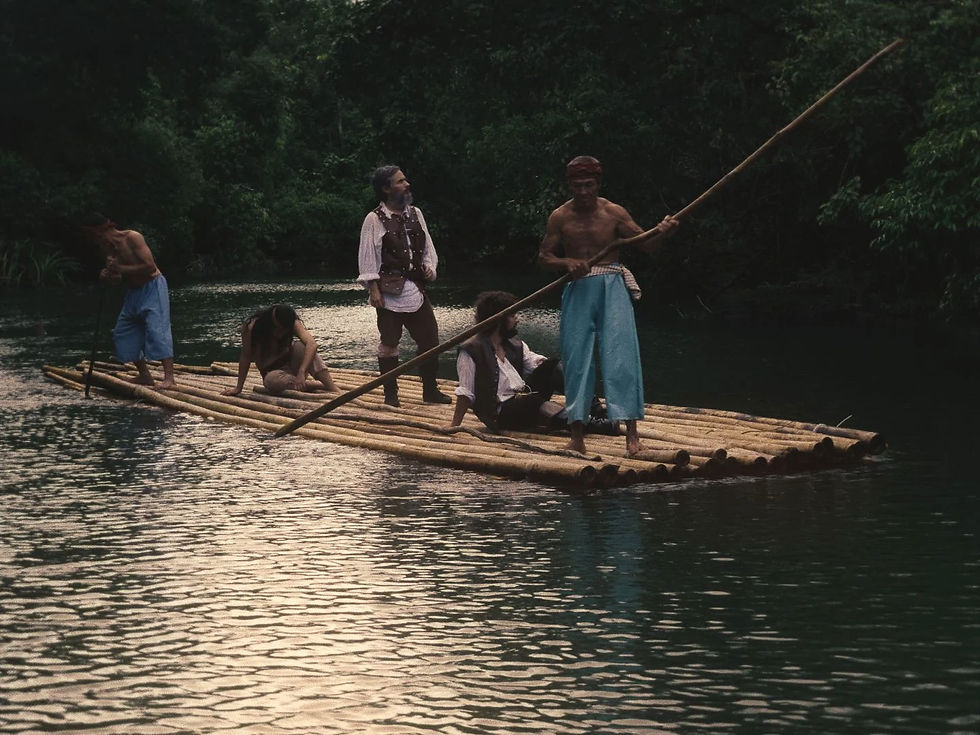
A metaphysical reflection underlies the story. Circumnavigation proves the world’s roundness, annihilating medieval cosmologies. This Copernican shift comes at a tremendous human cost: five hundred lives for geographical knowledge. The film meditates on the paradox between scientific progress and human suffering, between expanding knowledge and destroying cultures. Magalhães dies before completing the voyage, underscoring that History surpasses individuals — great transformations unfold beyond personal destiny.
The film also speaks to the present. Our era of instant imagery, where digital maps chart the planet’s every corner, struggles to imagine the terror of sailing toward absolute unknown. This film resurrects that primal fear of the abyss, the very real possibility of vanishing into oceanic nothingness. It reminds us that our technological mastery of the world is recent, fragile, reversible — especially in an age when climate change threatens to drown our certainties.
Magellan navigates masterfully between these three intertwined registers — epic, visceral, visionary. Each enhances the others. The film becomes far more than a historical biopic: it is a total meditation on humanity’s desire to transcend its boundaries, on the cost of progress, on the terrifying beauty of the unknown. A masterpiece honoring both the seventh art and the memory of the 534 sailors of whom only eighteen returned to Europe after three years of odyssey. A necessary work reminding us that every line on our maps was first carved into the flesh of explorers sacrificed on the altar of knowledge.
French release scheduled for December 31, 2025.


