Furcy, Born Free

Furcy, Born Free
Dignity on the Edge of the Abyss
By Anthony Xiradakis
“The ink of masters draws chains; the ink of resisters engraves History.”
Law can lie. Legal systems devised by human beings sometimes carry within them a particular kind of violence, one that turns humanity into merchandise, flesh into property, existence into a commercial transaction. The cinema of Abou Ndiaye confronts this fundamental contradiction: how can one remain oneself when the legal system decrees one’s non‑existence? How can the essence of freedom be preserved when every institution conspires to confiscate it?

The island of Bourbon breathes the poisonous beauty of colonial paradises. Sugar cane fields ripple under the trade winds, hiding the blood that nourishes their growth. Tropical light bathes the plantations while concealing the moral darkness of the slave system. This visual dichotomy structures the entire film: overwhelming natural splendour coexists with institutional horror, generating an almost unbearable aesthetic tension that sends chills down the spine.
Furcy embodies absolute, ontological resistance. Born to a freed mother, he theoretically inherits his liberty through maternal lineage under the Roman‑law principle of partus sequitur ventrem. Yet his owner, Routier, falsifies the documents, fabricates a non‑existent servitude, and turns a free man into a slave through the sheer power of administrative writing. This violence by ink reveals the totalitarian force of the document: a signature erases your humanity, a stamp deletes you from the register of legal persons.
The legal battle lasts twenty‑seven years. Twenty‑seven years spent pleading for his own existence before courts that regard his claim with the amused condescension reserved for talking objects. Judges gravely deliberate whether the man standing before them belongs to the category of legal subjects or of movable property. This bureaucratic monstrosity reaches Kafkaesque heights: one must prove being human to a system that has codified one’s transformation into a “thing”.
The direction embraces the long temporality of this legal struggle. Shots stretch and breathe at the exhausting rhythm of endless procedures. Each hearing becomes an administrative Via Crucis where hope briefly flares up only to crash against judicial indifference. The filmmaker captures this psychological erosion with clinical precision: shoulders that slump almost imperceptibly, eyes that lose a little of their fire after each dismissal, hands that tremble as yet another summons is opened.
The lead actor crafts a Furcy inhabited by an inner certainty that transcends daily humiliation. His physical presence defies the servile condition imposed on him. Every gesture has the sovereign economy of those who know their intrinsic worth. His silence in the face of insults carries more force than a thousand fiery speeches. This restrained performance amplifies the film’s core idea: freedom first asserts itself in posture, in the bodily refusal of submission.
The film directly confronts the legal schizophrenia of France at the time. The Revolution proclaims the universality of human rights while maintaining colonial slavery. The first article of the 1789 Declaration states that all men are born free and equal in rights; at the same time, the Code Noir meticulously regulates the exploitation of Black bodies. This explosive contradiction runs through the narrative: how can one and the same nation base its legitimacy on emancipation while perpetuating enslavement?
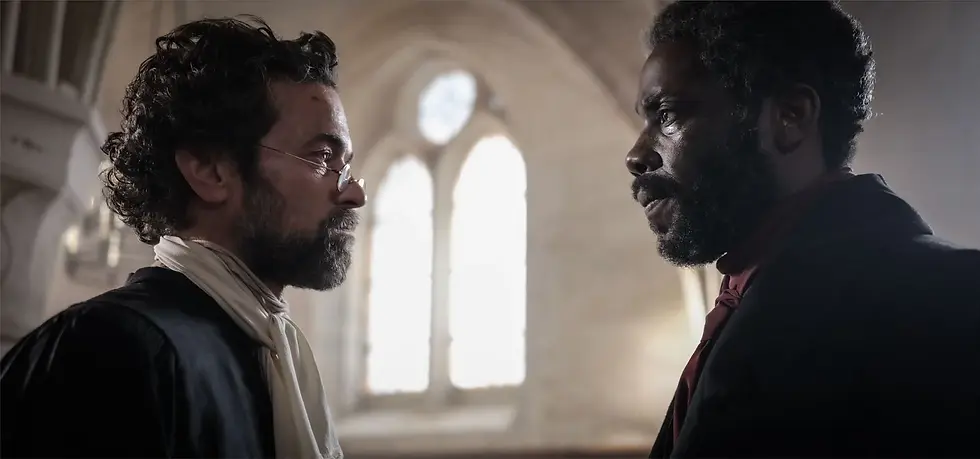
The courtroom scenes function like allegorical tableaux. On one side, the black robes of the magistrates symbolise state authority; on the other, Furcy in coarse clothing embodies the radical vulnerability of the dispossessed litigant. This visual asymmetry materialises the structural imbalance: a lone man facing the full might of a judicial apparatus complicit with slavery. The white lawyers who dare to defend Furcy in turn become suspect in the eyes of their peers, traitors to their caste for having acknowledged the plaintiff’s humanity.
Colonial violence surfaces in the banality of its paperwork. Whip marks tear into backs, of course, but the film focuses even more on the muted brutality of legal dehumanisation. Civil registers that erase a free birth to replace it with a fabricated servile status. Notarial deeds that appraise a man on the same terms as livestock. Court rulings that confirm his condition as owned property. This bureaucracy of contempt inflicts a metaphysical suffering that exceeds physical torture: even the very possibility of being is denied.
The cinematography works with harsh, deliberate contrasts. The dark interiors of courtrooms, steeped in sepulchral gloom, stand in stark opposition to the blazing exteriors of Réunion Island. This play of light translates the rift between the natural truth of freedom and the juridical obscurantism of slavery. Plantation sequences alternate between the splendour of the landscape and the ugliness of social relations, producing a visual unease that forbids any peaceful contemplation of the setting.
The script rejects simplistic, idealised militancy in favour of historical complexity. Furcy makes strategic mistakes, alienates certain allies through his intransigence, and pays the price for his uncompromising temperament. This humanisation of the hero paradoxically reinforces the film’s message: he remains fallible, imperfect, subject to doubts and outbursts, and thus fully human. His greatness lies precisely in his perseverance despite these flaws, in his stubborn insistence on legal existence despite the obstacles.
The work is a profound meditation on the performative nature of law. Statutes do not merely describe social reality; they create it. By declaring Furcy a slave, the colonial judiciary retroactively manufactures his servitude. Conversely, the final judgment recognising his original freedom reveals the fictitious nature of twenty‑seven years of captivity. This demiurgic power of legal language both fascinates and terrifies: the words of judges quite literally make and unmake lives.
Questions of identity run through the film. Furcy clings, against all odds, to the memory of his free birth. This fidelity to self becomes the ultimate act of resistance: preserving an unshakable awareness of one’s dignity despite institutions bent on denying it. His very name, “Furcy”, turns into an identity talisman, an anchor in a lineage of freed people that the slave order tries in vain to erase.
Furcy, Born Free achieves a rare cinematic feat: transforming a legal case into a philosophical meditation on human dignity. Abou Ndiaye directs with ascetic rigour, refusing the easy path of sentimental overstatement. His protagonist advances through History with the mineral determination of those who carry an irrepressible truth within them. The film becomes far more than a militant biopic: it is a masterful reflection on what constitutes our humanity when the world conspires to deny it. A necessary work that reminds us freedom is always wrested from the claws of power—hearing after hearing, day after day—with nothing but the stubborn assertion of one’s own existence.
“Furcy reminds us of an enduring truth: dignity always comes before the law that merely recognises it.”


