THE RUNNING MAN

THE RUNNING MAN
Survival in Its Rawest Form
By Imanos Santos
Relentless. Electric. Prophetic.
Relentless
The machine crushes. It crushes bodies, hopes, illusions of justice. Ben Richards discovers this truth when the system rejects him definitively. A blacklisted construction worker, father to a sick daughter demanding unaffordable medicine, he traverses existence with that exhaustion marking the socially condemned. Every door remains shut. Each refusal drives deeper the nail of his misery. Then emerges the sole escape: The Running Man, that television game where the poor die to entertain the rich.

Edgar Wright films this relentless machinery with the precision of a sadistic clockmaker. Thirty days of flight, professional hunters launched on his trail, a billion dollars at the carnage's end. Nobody has ever survived. The rules remain simple: run or die. The entire country scrutinizes screens, every citizen invited to report his position. Cameras surveil, gazes track, informants proliferate. All of America becomes hunting ground.
Glen Powell embodies this desperate man far from Arnold Schwarzenegger's oiled muscles in the 1987 version. Wright wanted an ordinary father propelled into extraordinary violence. Powell destroyed his body during the freezing Bulgarian weeks. Nighttime sequences in the snow, torso nearly bare suspended at the eighth floor, barely a towel to protect his modesty. Wright sipped his coffee on the ground, bundled in his parka, watching his actor shiver to capture this authentic suffering.
Josh Brolin infuses Dan Killian with that venomous charisma of suited predators. He recruits Richards with golden promises, knowing perfectly well he sends this man to slaughter. The producer orchestrates the massacre with a businessman's ordinary efficiency. Killian represents this bureaucratic violence, this institutionalized cruelty where nobody directly assumes the spilled blood. He signs contracts, programs sequences, maximizes audiences. The relentless wears a suit and tie.
Lee Pace interprets one of the most formidable hunters, professional killer transforming the hunt into premium spectacle. Each elimination obeys a lethal choreography repeated until perfect efficiency. These assassins work methodically, applying their murderous protocols with professional rigor. Death becomes routine, horror banal daily occurrence.
Wright orchestrates several sequences where brutality erupts without warning. An explosion devastates a Boston hotel from the basements, Ben extracting himself from flames in destructive choreography. The flight crosses all of America, each state becoming potential trap. The filmmaker refuses any respite: barely escaped from one danger, Richards plunges into the next. The relentless advances at constant speed, lethal metronome rhythming this frantic race.

Electric
Current flows through the screen. Chung-hoon Chung captures this nervous energy with his mobile camera, carving space into rapid visual fragments. Paul Machliss edits with that dry velocity become the filmmaker's signature since Baby Driver. Shots link at sustained rhythm, maintaining constant adrenaline. Wright injects his characteristic humor into this dark material. Powell delivers sharp replies and sarcastic commentary even at the most perilous moments.
Television studios sparkle with violent light. Colman Domingo animates the program facing bloodthirsty spectators, charismatic host of daily barbarity. His performance electrifies the studio, galvanizes crowds. He transforms each hunt into national event, each death into visual apotheosis. Audiences explode, bets soar, collective excitement reaches dizzying peaks.
Powell embodies this electrifying duality: fundamental gentleness and hardness acquired by necessity. His Richards seduces both the interior spectators of the film and those installed in dark theaters. The Texan definitively proves his rising star status. After Hit Man, Anyone But You and Twisters, here stands his most physically demanding demonstration. He combines accessible charisma and brutal determination, displayed vulnerability and unsuspected resistance.
Michael Cera surges in an unusual register, nervous activist managing his father's hot-dog cart while dreaming of overthrowing the regime. His feverish energy contrasts with apparent general resignation. Katy O'Brian incarnates a trapped contestant, pure ferocity concentrated in athlete's body. Emilia Jones crosses the screen as hyperactive civilian Ben captures to facilitate his escape, verbal delivery machine-gunning every silence.
Wright abandons London streets to embrace a continental fresco filmed across multiple countries. Snowy Bulgaria furnishes hostile décor and merciless temperatures. The filmmaker wanted this visible climatic brutality, this authentic physical suffering. Every shot vibrates with palpable urgency. Pursuits chain together, explosions tear through, blows strike home. Electricity flows through each sequence, charging the atmosphere with maximum tension.
This frenetic energy structures the entire narrative. Wright refuses all contemplation, all meditative pause. He propels his hero from one perilous situation to the next, multiplying obstacles and twists. The film advances at high velocity, sweeping the spectator into its whirlwind. Even calm moments crackle with latent anxiety: the hunt will resume soon, hunters approach, danger lurks.

Prophetic
In 1982, Stephen King published under pseudonym a dystopia set in 2025. Forty-three years later, Edgar Wright adapts this premonitory nightmare at the precise moment when fiction nearly joins our reality. The novelist's predictive algorithm terrifies: here stands exactly the year he had chosen to install his hell. The distance between his vision and our present has shrunk dangerously.
King described an authoritarian America controlled by giant corporations, keeping the populace distracted by mind-numbing programs and modern gladiators. Television devoured humanity, the rich contemplated the poor massacring each other for their entertainment. This literary projection resonates today with troubling acuity. Reality television programs still dominate popular culture, social networks transform everyone into potential scandal broadcasters, violence spectacle attracts considerable audiences.
Wright and Michael Bacall, writing accomplice since Scott Pilgrim vs. The World, restore this prescience of the original novel. Where the 1987 film transformed everything into fluorescent 80s spectacle, this version plunges into King's sociological darkness. Violent contrasts between impoverished neighborhoods and sparkling studios reveal the abyss separating social classes. Failing healthcare systems condemn poor families to choose between subsistence and survival. Police oppression maintains inequitable order.
Stephen King appears in the executive producers' credits. Wright had contacted Schwarzenegger before filming to obtain his blessing. The Austrian actor actually appears in the film as photograph, his face printed on future hundred-dollar bills. This symbolic transmission seals the passage between two eras, two gazes brought to the same narrative material. The former muscled champion yields place to vulnerable hero, reflection of a society where brute force suffices less against systemic oppression.
The film arrives in French theaters November 19, 2025, at the heart of a turbulent American electoral period, while debates about media, manipulation and truth saturate public space. Timing reinforces the subject's relevance further. What King imagined in 1982 materializes progressively before our eyes. Boundaries blur between entertainment and torture, spectacle and torment, dystopian fiction and daily news.
Wright transforms this literary premonition into nervous cinematic experience interrogating our relationship to violence spectacle, our passive complicity before televised injustice. Richards runs for his life while millions applaud his ordeal. This collective indifference facing individual suffering summarizes the warning King launched four decades earlier. The public consumes human misery transformed into entertainment, absolving its conscience by invoking participants' free will.
William H. Macy appears as fragile ally, furnishing false identities and pathetic disguises. His character incarnates this minuscule resistance against total oppression. A few individuals still attempt to help, protect, save. But their efforts resemble water drops thrown on a fire ravaging everything. King's prophecy reveals this growing powerlessness of ordinary citizens facing massive power structures.
Edgar Wright signs here his most expensive project, his longest shoot, his most ambitious production. He wanted this visible climatic brutality on screen, this authentic physical suffering transcending Hollywood artifice. Powell respected his initial promise: no actor would have worked harder. This physical authenticity reinforces the work's prophetic dimension. King had predicted our future; Wright films it with brutal honesty rendering the held mirror even more uncomfortable.
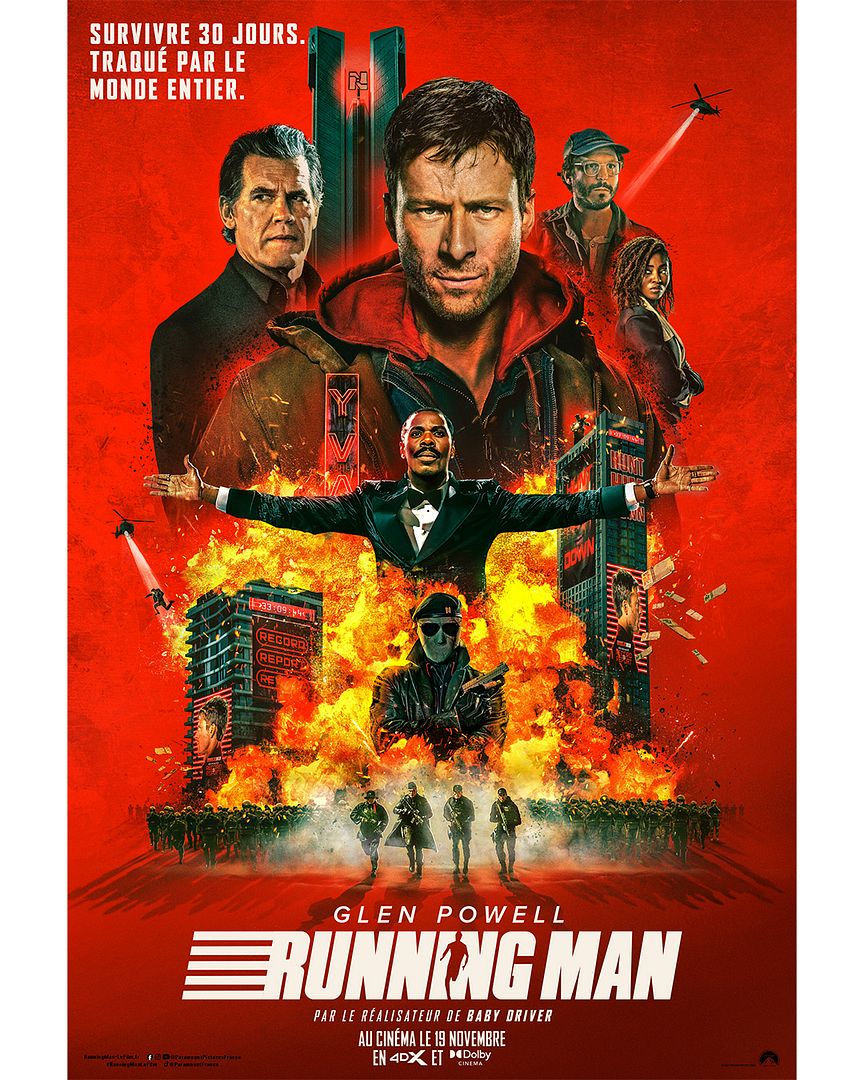
The Running Man arrives at the precise moment when we can still choose another trajectory. The prophecy remains avoidable. But the film suggests that each passing day, each accepted compromise, each tolerated injustice brings us inexorably closer to the nightmare glimpsed by King in 1982. Richards runs to survive. We watch his race without really moving. This collective passivity perhaps constitutes the novel's most terrifying prediction become reality.
Wright delivers an adaptation honoring fully its triple promise. Relentless in its narrative machinery crushing its hero without respite, electric through the raw energy Glen Powell breathes into every shot, prophetic in its capacity to reveal how King's dystopia resonates with our present: this Running Man strikes with force persisting long after the final credits. The British filmmaker transforms the deadly race into mirror held up to a society preferring to contemplate violence rather than confront it.
-------------------------------------------------------------------------------------
Article written by Imanos Santos
Advertising & Communication Director: Laure Jourdan
Graphic Design: Azaes Création
Editor-in-Chief: Marie-Ange Barbancourt
Publishing Director: Rémy Bonin
Founder & Creator of the Magazine: Serge Leterrier
Published by Diamont History Group Media
---------------------------------------------------------------------------------------


