MERCY

MERCY
When Thriller Becomes Mental Architecture
Par Anthony Xiradakis
“When the machine becomes judge, innocence itself transforms into algorithm — and the time remaining measures less a life than an entire civilization facing its own vertigo.”
January 23, 2026
Cinema traverses today a silent metamorphosis. Mercy, this anticipated thriller arriving next January, perhaps embodies this profound mutation where the screen ceases to be window and becomes labyrinth. The question emerges: what do we truly film when the camera captures a crime? Bodies in motion? Nocturnal settings? Or this thing far more vertiginous: thought itself forming, deforming, tracing its own interior geographies?

The thought-image imposes itself here as revelation. It surpasses mechanical capture of reality to embrace that dimension where each shot becomes synapse, where each editing cut mimics the very functioning of our fragmented consciousness. Thriller, a genre renowned for its strict codes and conventions, reveals itself as fertile ground for this exploration. For what is suspense if otherwise than a precise orchestration of the spectator's mental states? What is narrative tension if otherwise than virtuoso manipulation of our anticipations, our fears, our repressed desires?
Mercy — this title itself resonates differently depending on whether we hear it in its religious dimension or in its desperate plea — could well embody this philosophical vision of the seventh art. Crime in cinema becomes laboratory where affect formation observes itself, where moral violence dissects itself as much as physical. Each wide shot on urban landscape transports with it all metropolitan anguish; each close-up on a face reveals the geological strata of the human soul.
Deleuze spoke of time-image and movement-image. But here emerges a third category: the consciousness-image, this cinematographic space where visible and invisible fuse, where the raw materiality of film or pixel charges itself with conceptual intensity. The spectator becomes co-creator, their brain extending the work initiated by the filmmaker, weaving unprecedented connections between sequences, projecting their own ghosts into zones of shadow left deliberately gaping.
The crime thriller possesses this unique capacity to map our relationship to Evil. Each filmed investigation traces a moral topology, each unmasked culprit reveals our own ambivalences. Mercy seems to promise this plunge into the abysses of collective psyche. The detective genre, far from simple entertainment, operates as social radiography: it exposes our archaic fears, our unavowable desires for transgression, our morbid fascination with the fall.
The classic photographic image freezes time. The cinematographic image makes it flow. But the thought-image stratifies it, multiplies it, renders it simultaneously present and future, real and fantasized. When the filmmaker composes their frame, they orchestrate infinitely more than aesthetics: they program a cognitive experience, a sensory adventure where the spectator travels through their own mental mechanisms.
This approach radically transforms our understanding of the medium. Cinema ceases to be reproduction of the world to become production of possible worlds. Each film opens a parallel universe governed by its own physical and metaphysical laws. Mercy, with its promise of criminal tension, could well reveal this fundamental truth: true suspense always occurs inside, in that murky zone where our certainties waver, where our moral bearings dissolve.
The complex sensory construction that the thought-image represents mobilizes all our senses, even those the screen seems to ignore. We hear the heavy silence of a mute scene; we feel the icy texture of a prison wall; we perceive the smell of fear in the short breath of a hunted character. Cinema becomes synesthetic, it activates multiple cerebral zones, it awakens buried memories.
January 2026 will perhaps see emerge with Mercy this new filmic consciousness. The crime projected on screen will serve as pretext for an investigation far more vast: that of our own mental functioning, our psychic blind spots, those interior territories where primitive forces still prowl. The thought-image triumphs then: it reveals that each shot contains a world, that each sequence carries a philosophy, that cinema entirely constitutes a language to speak the unspeakable of human experience.
The frontier between seeing and thinking fades. To watch Mercy will be to think with the image, through it, thanks to it. Criminal spectacle becomes meditation on chaos, thriller transforms into metaphysical treatise. The screen, bidimensional surface, opens onto infinite dimensions where consciousness explores its own abysses, where imagination encounters its own limits, where humanity entirely confronts what it refuses to see in itself: that capacity for evil which slumbers, that fascination with destruction which pulses beneath civilizational veneer.
Cinema thus reinvents its mission: to transform each screening into interior journey, each projection into collective introspection. Mercy arrives perhaps at the perfect moment to embody this silent revolution, to demonstrate that thriller surpasses entertainment and touches philosophical sublime. The thought-image now reigns over the empire of projected shadows.
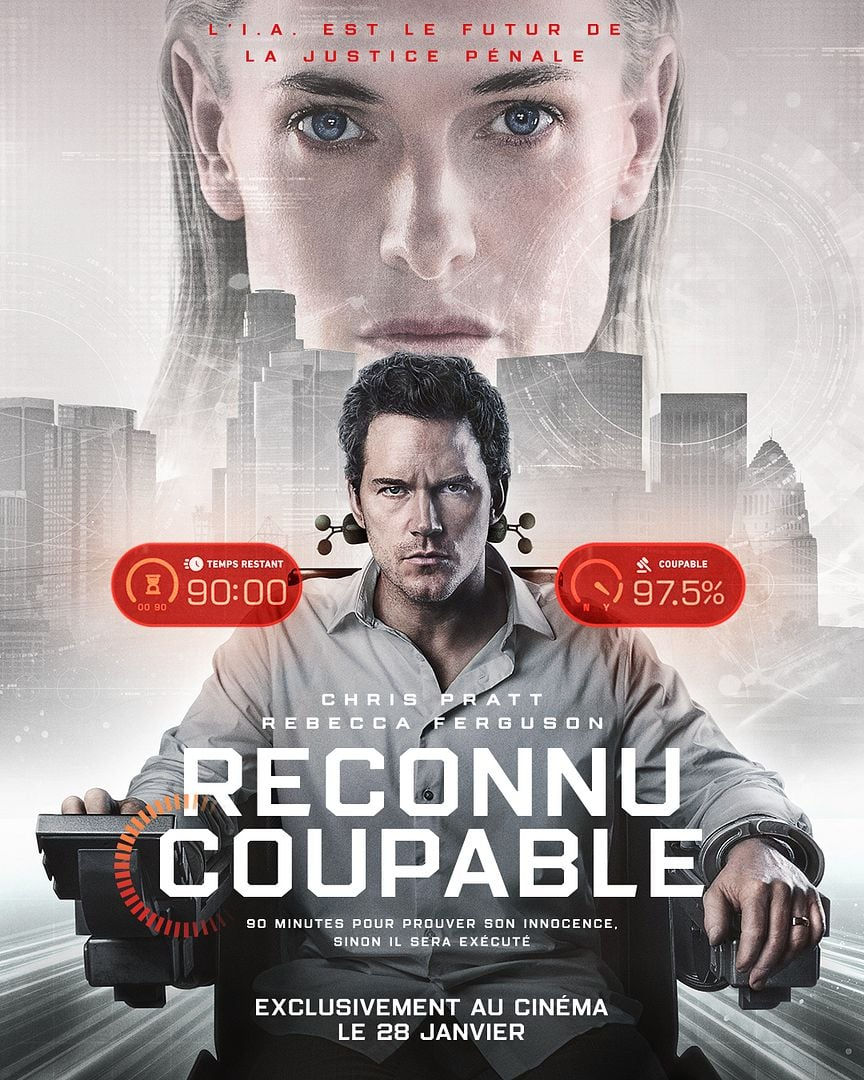
MERCY
Release: January 28, 2026
Visual thriller master Timur Bekmambetov (Wanted, Unfriended) returns with a futuristic vertigo where justice itself becomes executioner. Chris Pratt embodies a detective trapped by his own creations: accused of his wife's murder, he must convince in ninety minutes a merciless artificial intelligence — the very one he had helped bring into the world. Rebecca Ferguson lends her glacial voice to this algorithmic judge who will seal his fate. Alongside Pratt, a powerful cast: Annabelle Wallis, Kali Reis (True Detective: Night Country), Chris Sullivan, and Kenneth Choi. Marco van Belle signs a screenplay where countdown becomes metaphor for a civilization having abdicated its humanity in favor of technological performance. Between Minority Report and Blade Runner, Mercy interrogates: who truly judges when machine replaces consciousness? Produced by Charles Roven (Oscar for Oppenheimer), this science-fiction thriller promises a hallucinatory plunge into the abysses of a society that would have forgotten that justice demands what algorithm ignores: doubt.
Direction: Timur Bekmambetov
With: Chris Pratt, Rebecca Ferguson, Annabelle Wallis, Kali Reis, Chris Sullivan, Kenneth Choi
Production: Atlas Entertainment, Bazelevs Production
Distribution: Sony Pictures (France), Amazon MGM Studios (United States)
-------------------------------------------------------------------------------------
Article written by Anthony Xiradakis
Advertising & Communication Director: Laure Jourdan
Graphic Design: Azaes Création
Editor-in-Chief: Marie-Ange Barbancourt
Publishing Director: Rémy Bonin
Founder & Creator of the Magazine: Serge Leterrier
Published by Diamont History Group Media
---------------------------------------------------------------------------------------


