SHEEP IN THE BOX

Updated: May 11
SHEEP IN THE BOX
A film by Hirokazu Kore-eda
The Birth of a Bond
Presented in the Official Selection of the 79th Cannes International Film Festival
Lyssandra DL — For Diamont Media
In Sheep in the Box, Hirokazu Kore-eda accompanies the birth of a relationship with infinite delicacy. Between presence and projection, the film explores what lies beyond the real — and what allows attachment to take form.
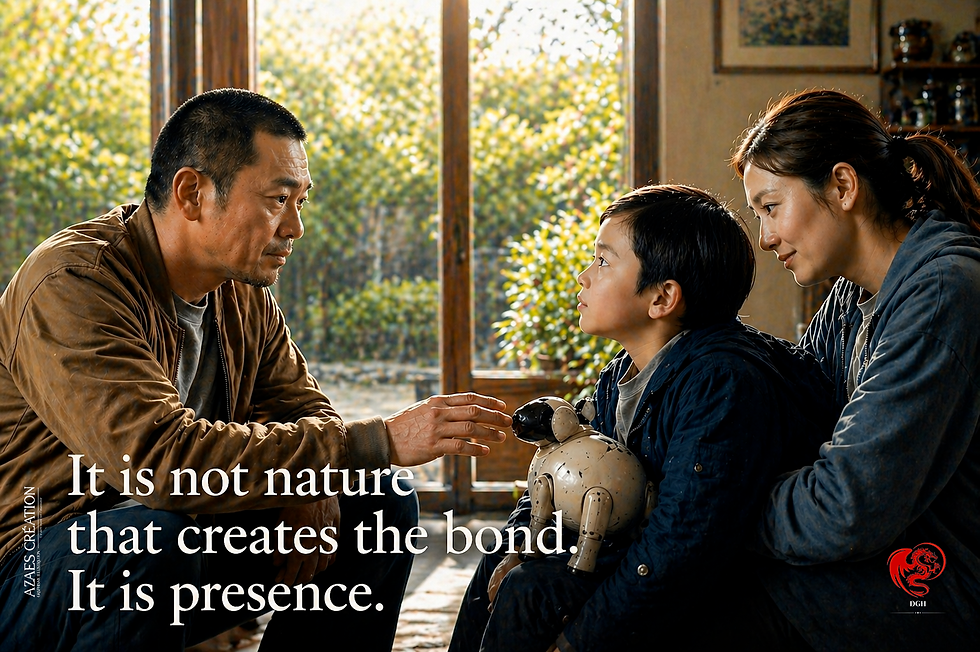
Hirokazu Kore-eda is one of the most attentive filmmakers alive to what quietly unfolds between human beings. Palme d'Or winner in 2018 for Shoplifters, he returns to Cannes with a work that gently but profoundly shifts the boundaries of what we call loving. In Sheep in the Box — a title drawn from a line in Saint-Exupéry's The Little Prince — a couple who have lost their child welcome a humanoid robot, a perfect replica of their lost son. This is not science fiction in any spectacular sense. It is a question posed with infinite care: from what moment does the presence of another, whatever their nature, become real for the one who loves?
One enters this film softly, almost on tiptoe. Nothing imposes itself. Everything settles. A presence, a rhythm, a way of looking that invites one to slow down and feel differently. Kore-eda returns here to his singular capacity for observing bonds in their most fragile and most essential form. The film accompanies a couple as they welcome a child. The situation appears simple, almost familiar. Yet very quickly, a nuance appears — a slight distance between what one sees and what one feels. That distance creates no rupture. It opens a new space in which the relationship takes shape with delicacy, with hesitation, with a kind of modesty. One witnesses the birth of an attachment that rests not on immediate certainty, but on a progressive attentiveness.
Kore-eda films these moments with precision, fragility, and sensitivity. Gestures take on a particular weight. A hand placed gently, a prolonged gaze, a silent presence. Every detail becomes meaningful. Every movement participates in a larger construction. Within this space, the child occupies a central place — almost luminous. His singularity acts as a revealer. It brings to light the projections, the expectations, the impulses of the couple. It invites an interior displacement, a different way of receiving the other. One senses a transformation without roughness. Attachment takes form. It does not impose itself — it unfolds. It grows in the interstices, in moments of stillness, in that way of being present without seeking to define what is immediate.

The film accompanies this movement with great tenderness. It lets time do its work. It gives each emotion the space to settle. Nothing seeks to accelerate. Nothing forces the passage. The experience builds in duration, in an attentive listening to what emerges. One allows oneself to be carried by this temporality. The gaze adapts. Attention sharpens. A form of openness settles in, almost instinctive. One observes the evolutions, feels the shifts, accompanies this birth of connection as a living process.
The gentleness of the film does not come only from its rhythm. It comes from its gaze. A deeply human gaze, one that receives each character in their complexity, in their fragility, in their particular way of moving forward. Emotions circulate with great fluidity. They appear, transform, and settle. They find their place in a space that receives them with accuracy. One feels a particular closeness to these moments — as though the film were touching something familiar, something deeply shared.
Through this story, Kore-eda explores an essential dimension of human connection. Attachment does not depend solely on what is given. It is built. It is learned. It is nourished by presence, by attention, by recognition. One perceives then a quiet truth. To love requires an openness — a capacity to receive what comes without seeking to fix it in place. A way of being with the other, in their singularity, in their difference, in their particular manner of existing.
Sheep in the Box offers a sensitive, almost interior experience. It invites one to slow down, to listen, to look with renewed attention. It reminds us that the deepest bonds are often built in simplicity, in continuity, in a sincere presence. Within this space, the child becomes far more than a character. He embodies a possibility. An opening. A way of rethinking connection from what is lived, what is felt, what is shared. One accompanies the couple through this transformation. One discerns the adjustments, the hesitations, the moments of clarity. One feels the way each person gradually finds their place within this relationship still taking form.

The film moves with great truthfulness. It does not seek to demonstrate. It allows things to be seen. It allows things to appear. It accompanies an interior movement that unfolds with great softness. Within that movement, something is created. A bond. A presence. A form of quiet evidence that arrives slowly. One leaves the film with a sense of peace — a sense of having touched something simple and profound. A felt understanding of what connects beings to one another, beyond frameworks, beyond certainties.
Sheep in the Box offers a delicate experience, sustained by a constant attention to what is human. It reminds us that bonds are built in time, in listening, in a presence willing to be transformed. And within that transformation, one thing remains.
The capacity to love, in all its candour.
"Love takes form in the attention we offer to the other." — Lyssandra DL
In theaters December 16, 2026 | Drama